Xrp cryptocurrency
EOS technology allows developers to create decentralized apps (DApps) that support decentralized finance (DeFi) and offer scalability, security, and flexibility. The EOS blockchain launched in June 2018. https://funanimaux.com/ Its coin sells for $1.15 as of March 12, 2024. As of August 4, 2024, EOS’s price is $0.44.
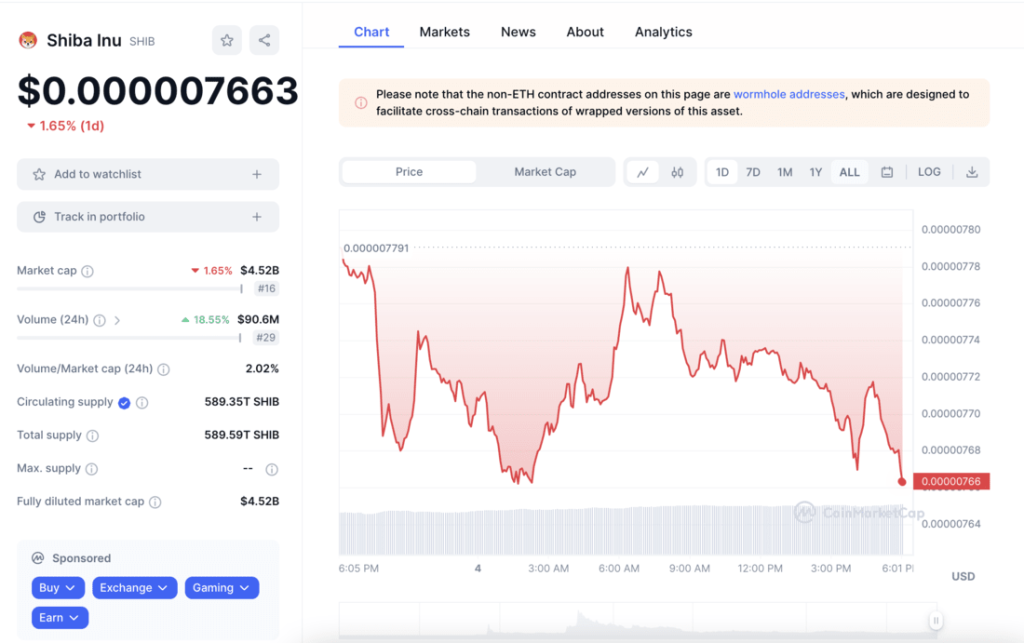
Each of our coin data pages has a graph that shows both the current and historic price information for the coin or token. Normally, the graph starts at the launch of the asset, but it is possible to select specific to and from dates to customize the chart to your own needs. These charts and their information are free to visitors of our website. The most experienced and professional traders often choose to use the best crypto API on the market. Our API enables millions of calls to track current prices and to also investigate historic prices and is used by some of the largest crypto exchanges and financial institutions in the world. CoinMarketCap also provides data about the most successful traders for you to monitor. We also provide data about the latest trending cryptos and trending DEX pairs.
One of the biggest winners is Axie Infinity — a Pokémon-inspired game where players collect Axies (NFTs of digital pets), breed and battle them against other players to earn Smooth Love Potion (SLP) — the in-game reward token. This game was extremely popular in developing countries like The Philippines, due to the level of income they could earn. Players in the Philippines can check the price of SLP to PHP today directly on CoinMarketCap.
What is cryptocurrency mining
The difficulty level for mining on September 15th, 2024, was 92.67 trillion. That is, the chances of a computer producing a hash below the target is 1 in 92.67 trillion. To put that in perspective, you are about 286,000 times more likely to win the Powerball Grand Prize with a single lottery ticket than you are to pick the correct hash on a single try.
As a crypto miner, you can choose from several ways to mine. You can mine as an individual, in the cloud, or as part of a larger pool of miners. Examine how each works in more detail to help guide you in choosing the method that will work best for your circumstances.
Most pools use a payout system based on how much work you contribute. For instance, if you have a GPU providing 121 mega (million) hashes per second and the pool has a total hash rate of 121 exa (quintillion) hashes per second, your reward, based on the shares of work you contributed, would be very small.

The difficulty level for mining on September 15th, 2024, was 92.67 trillion. That is, the chances of a computer producing a hash below the target is 1 in 92.67 trillion. To put that in perspective, you are about 286,000 times more likely to win the Powerball Grand Prize with a single lottery ticket than you are to pick the correct hash on a single try.
As a crypto miner, you can choose from several ways to mine. You can mine as an individual, in the cloud, or as part of a larger pool of miners. Examine how each works in more detail to help guide you in choosing the method that will work best for your circumstances.
Cryptocurrencies
The validity of each cryptocurrency’s coins is provided by a blockchain. A blockchain is a continuously growing list of records, called blocks, which are linked and secured using cryptography. Each block typically contains a hash pointer as a link to a previous block, a timestamp, and transaction data. By design, blockchains are inherently resistant to modification of the data. It is “an open, distributed ledger that can record transactions between two parties efficiently and in a verifiable and permanent way”. For use as a distributed ledger, a blockchain is typically managed by a peer-to-peer network collectively adhering to a protocol for validating new blocks. Once recorded, the data in any given block cannot be altered retroactively without the alteration of all subsequent blocks, which requires collusion of the network majority.
An initial coin offering (ICO) is a controversial means of raising funds for a new cryptocurrency venture. An ICO may be used by startups with the intention of avoiding regulation. However, securities regulators in many jurisdictions, including in the U.S. and Canada, have indicated that if a coin or token is an “investment contract” (e.g., under the Howey test, i.e., an investment of money with a reasonable expectation of profit based significantly on the entrepreneurial or managerial efforts of others), it is a security and is subject to securities regulation. In an ICO campaign, a percentage of the cryptocurrency (usually in the form of “tokens”) is sold to early backers of the project in exchange for legal tender or other cryptocurrencies, often bitcoin or Ether.
Numerous companies developed dedicated crypto-mining accelerator chips, capable of price-performance far higher than that of CPU or GPU mining. At one point, Intel marketed its own brand of crypto accelerator chip, named Blockscale.
